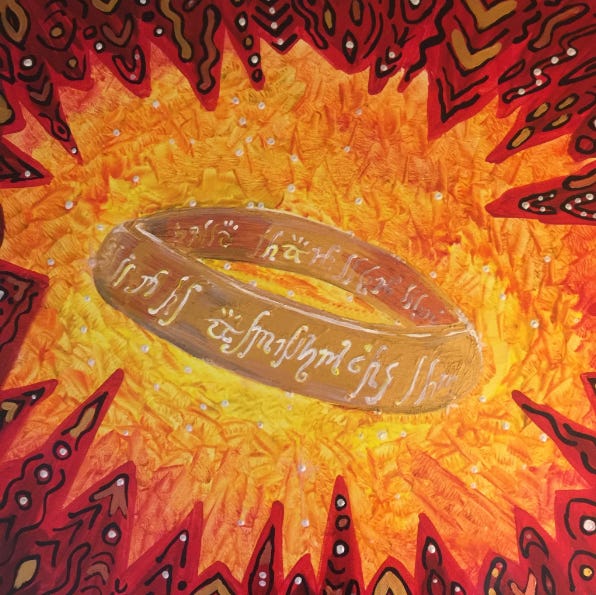
From These Ashes
What does this moment ask of us?

In the first book of The Lord of the Rings trilogy, The Fellowship of the Ring, in a chapter entitled “The Shadow of the Past”, Frodo feels overwhelmed by the darkness spreading across Middle-earth.
He says to Gandalf:
“I wish it need not have happened in my time.”
Gandalf replies:
“So do I,” ... “and so do all who live to see such times. But that is not for them to decide. All we have to decide is what to do with the time that is given us.”
Tolkien wrote these words while living through the upheaval and uncertainty of World War II.
This exchange speaks to the heart of what I’ve been grappling with lately. Like Frodo, I sometimes find myself wishing that the tribulations of our age did not have to occur in my time.
Yet here we are... witnessing conflict and massive injustice, the petulance and moral failures of leaders, their mocking of integrity, the fractures in our public life—it feels to me as if something essential has broken. Things we thought were solid—institutions, norms, shared truth—feel now as though they are crumbling and burning around us. In some cases, burning to ash.
Once something has transformed to ash, there is no turning back.
In my own faith tradition, one of the few rituals open to anyone who presents themselves is the distribution of ashes on Ash Wednesday. This ritual takes place while it is still winter and it signals the start of Lent. Churchgoers receive ashes on their forehead and hear the ancient words:
“Remember that you are dust, and to dust you shall return.”
This felt somewhat depressing for a little kid... or even irrelevant. These ashes remind us that we die and death seemed so far away to my child-self. (Not so now. ) But the symbolism doesn’t stop there. The ashes also remind us that we are alive right now, in this moment.
To the question: what does this moment ask of us?
Geneen Marie Haugen writes:
“...How do we find the way if we can’t see around the bend? ...In our time of disturbance and radical change, we are crossing a threshold, a portal, or an unseen bridge from one world to another. It could be said that the bridge is either collapsing beneath us, or being made as we walk together...”
I think maybe it is both.
The ashes remind us to look directly at reality—without despair, and without illusion... without numbing ourselves. They remind us that life is fragile, and that transformation is possible. And it is no coincidence that this particular ritual occurs just a few weeks before the vernal equinox, which literally completes the story.
Twice each year our planet reaches a moment when day and night are nearly equal across the globe. The vernal and autumnal equinoxes. The vernal equinox just took place two days ago.
Vernal means fresh or new... spring. Equinox means equal night—a moment when day and night are in balance. After the vernal equinox in the Northern Hemisphere, the days begin to grow longer than the nights. Light slowly gains the upper hand over darkness.
Across thousands of years, human cultures have marked this moment. Agricultural societies depended on it. The equinox meant the soil would warm. Seeds could be planted.
Different traditions mark this turning in different ways. Persian culture celebrates Nowruz, Spring--the new year. In the Jewish calendar, Passover occurs near the full moon after the equinox. Pagans celebrate the vernal equinox--calling it Ostara, as a time of balance, renewal, and fertility, marking the return of spring. Celebrations include planting seeds, adorning altars with spring flowers, and decorating eggs. In Christianity, Easter follows the first full moon after the equinox, celebrating resurrection—and somehow the decorating eggs made it through.
The details vary, but this renewal is in our DNA, Nature herself holds the story: after darkness, light returns.
Spring marks that turning point, reminding us that death is not the final word in the natural order. That from ashes, from dust, comes possibility. After death, new life.
We’ve seen that right here in Lake County. Just over a decade ago, the fires that swept through our county exposed how much of what we depend on can disappear overnight. Forests. Homes. For a while it wasn’t even clear what recovery would look like.
But something else happened too. Neighbors helped one another. Communities organized food and supplies. Businesses and families opened their doors to people who had nowhere else to go. Groups found ways to collaborate. We figured things out in real time, because there wasn’t a system designed for what had just happened.
And the land itself began its own regeneration--that first spring following the fires, the land erupted in a massive displays of wildflowers. Changed. but still alive.
Yes, we know what it is like to return from ash. Nothing is the same, but we are alive, right here, right now.
Returning to Tolkien and his epic tale—he made the point that dark times do not magically resolve themselves. In fact, he emphasized this point in his final (and what he considered important) chapter of The Lord of the Rings: entitled “The Scouring of the Shire.” It was famously left out of the movie likely because it wasn’t a tidy, happy ending.
In the story, Sauron, the central figure causing the chaos and death to Middle Earth is finally defeated. But when the hobbits return home (hoping for the idyllic life they had before), they found the Shire damaged and under petty tyranny.
Tolkien’s point: even after a dominant political figure passes from the center of power, the real work of restoring trust, repairing institutions, and rebuilding civic life, still must be done by the people who live there.
We may not get to choose the historical moment we inhabit. Like Frodo, many of us might say: “I wish it need not have happened in my time.”
In Gandalf’s reply, he, in a sense affirms the central question: What does this moment ask of us?
Maybe it asks us to for more courage to stand for justice. Maybe more compassion. Maybe acceptance of what we’ve lost. Maybe a greater imagination of what could be. No doubt, if we ask the question and stay present to what unfolds, something will require our attention and commitment. Because we are alive right here, right now.
And there is no turning back.
Nature shows us that new life is possible. But what grows—what kind of community, what kind of society, what kind of future—that part depends on us.
“All we have to decide is what to do with the time that is given us.”