

If you wonder “can we come back from this?” you are not alone.
When we see devastated places, communities, institutions, we might feel powerless. Or we might throw ourselves into making big policy changes — after all, don’t we need big change? Those engaged in this grueling policy work often feel discouraged and overwhelmed— it is not unlike swimming upriver.
“Politics is a strong and slow boring of hard boards.” - Max Weber
What if change didn’t have to be so difficult?
I don’t want to discourage anyone from political work. But I needed to learn, the hard way, that policy is not the only lever. And for some, it is not the right lever at all. The natural world teaches us that there are many ways to change our surrounds.
Nature has been regenerating devastated landscapes for longer than we have been making a mess of them. Earth has been “earthing” for a very long time and has quite a lot to teach us about thriving in hostile ecosystems and coming back from destruction and loss. I’ll write more about this in the coming months. Today, though, I’d like to share with you one of the regenerative tools that has inspired me the most:
A “seed ball.”
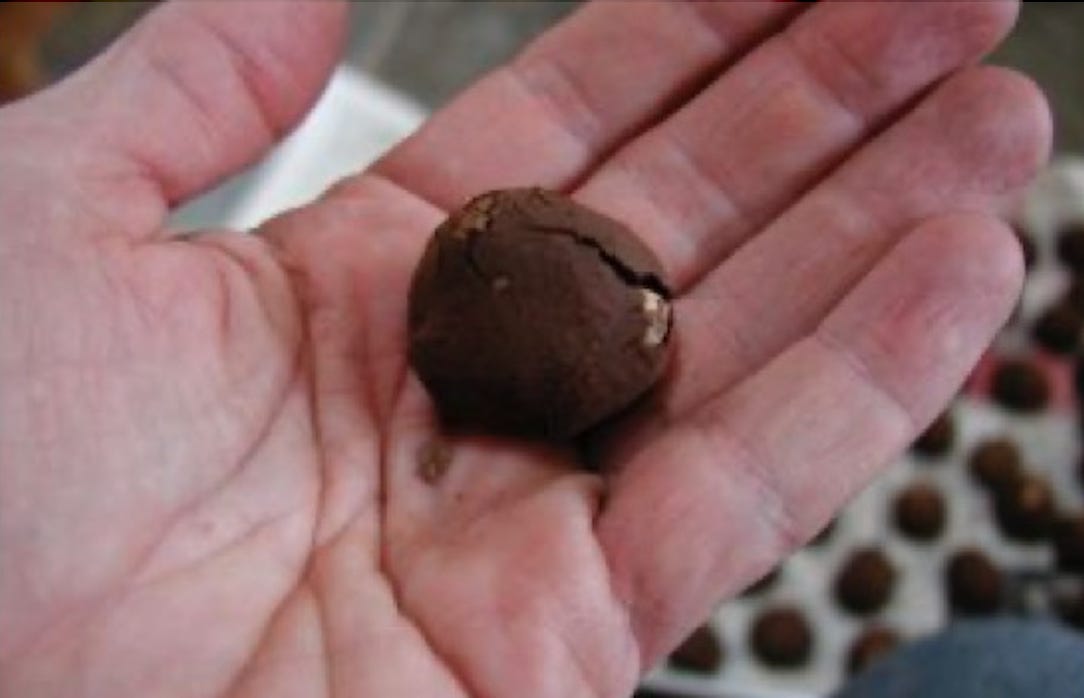
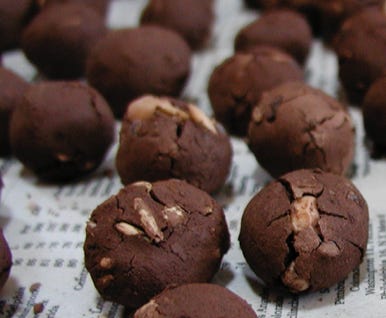
In ecological practice, seed balls are a way to start something new in a lifeless place. They come from an ancient method of propagating plants that was reintroduced by natural farmer and father of permaculture, Masanobu Fukuoka. They are particularly well-suited to restoring compacted, barren soils, or other disturbed or ravaged lands.
Imagine a landscape scraped clean. Then imagine what could be growing there—the first set of plants that might help restore that place. Contained within one seed ball is the entire restored landscape—a vision of the future of the place, full of life.
Seed balls are a mixture of clay and compost and a “guild” of seeds—a (future) group of plants that grow together in a self-sustaining system of mutual support, each with a role. Some plants in the guild provide structure, others draw needed nutrients, still others create protective biomass quickly.
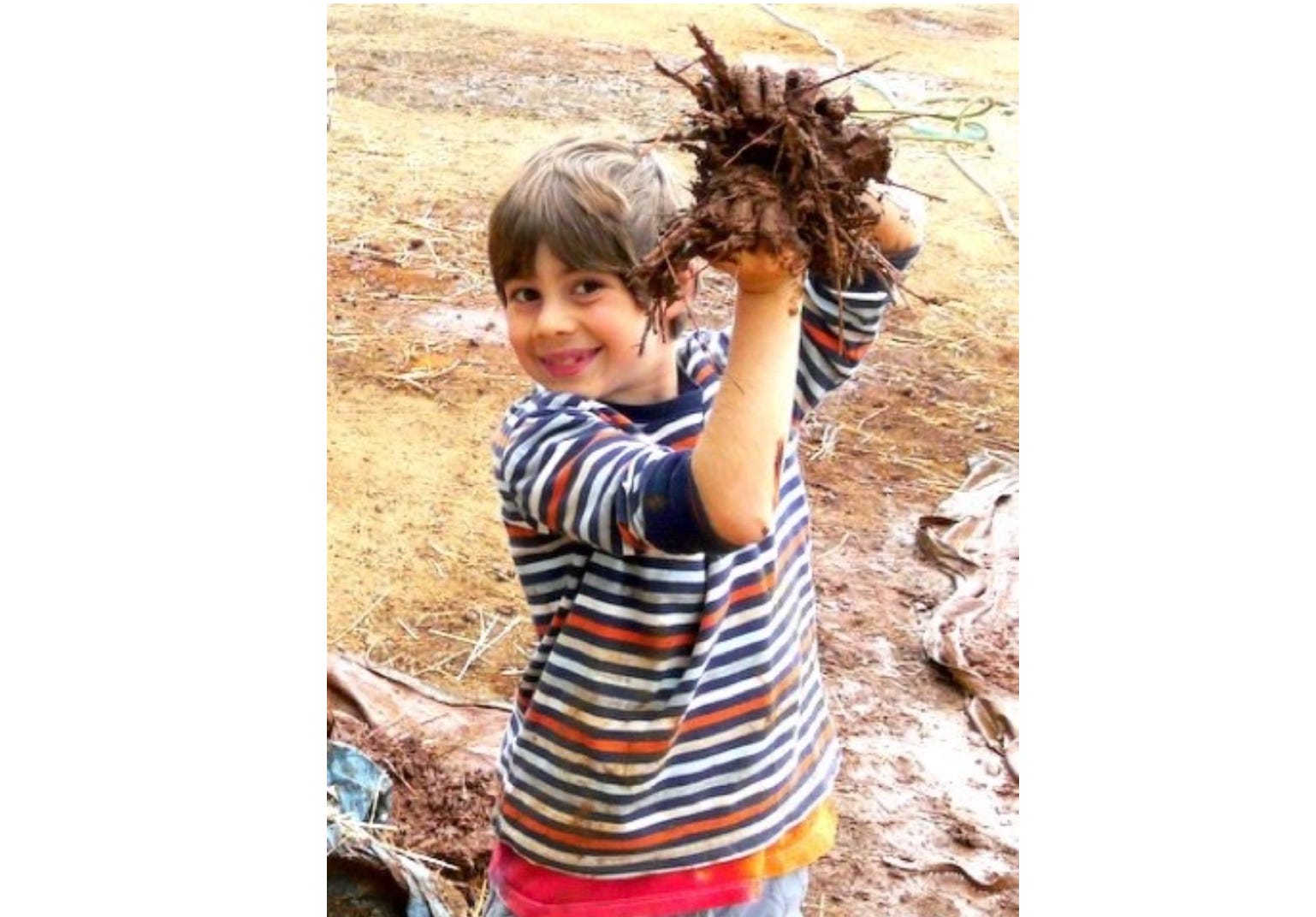
Kids love making seed balls. Hands in the mud, stirring the seeds and compost and clay like they are making brownies. Rolling them into balls.... and especially tossing them onto bare open land.
When a seed ball lands on barren ground, nothing happens at first.
That is the nature of seed balls.
A seed ball waits for the right time... when the moisture is right, when it’s not too cold. Then, the seeds germinate. Some sprouts grow tall and provide structure for other plants to climb. Some add nitrogen to the soil. The compost feeds these young sprouts until they establish themselves. The plants grow. When they eventually mature, they create more and more seeds.
You can make dozens of seed balls, hundreds, if you’re in the mood. You’re not betting on any one seed ball, you’re improving the odds. There is something almost mischievous about it… a handful of hope, flung into the world with intention rather than anxiety. Consider each one a little experiment.
Many of them fail. And that’s okay.
The ones that don’t can change the landscape.
After many seedball-inspired experiments here in my own community, here is what I noticed.
The projects that actually changed things in a lasting way were rarely the big ideas. They were the community garden that a handful of neighbors built on a forgotten lot. The permaculture design course that graduated forty people, each of them carrying forth a different understanding of how systems work and how to work with them. The small group that focused on fire recovery and fire safety in their neighborhood.
Small. Doable. Engaging.
None of these required a vote. None required a grant, a committee, a strategic plan. They required one or two people who believed the project was worth doing, and who chose a size that matched the energy available.
That is the whole secret, if there is one.
The problem I kept seeing — in myself, in colleagues, in the activists and sustainability advocates and elected officials who want to make a difference — was not lack of passion. It was not lack of knowledge. It was scale.
We aim too big and burn out. Or we aim so small that the work feels insignificant, and we stop.
Between those two edges is a narrow path. A project that is small enough to manage and strategic enough to matter. A project that is low-risk should it fail — because some projects will—and exciting or engaging enough that people want to be part of it.
Fun matters. I mean that seriously. An endeavor that draws people to show up and bring their neighbors is doing something that an analyst cannot measure and a policy document cannot mandate. It is restoring something vital.
Here is an example of a “seed ball” project:
On a patch of county land along Highway 20, not far from a local Foster’s Freeze, we built a bench.
Not an ordinary bench using a hammer and nails, but a cob bench — the ancient building material of clay, sand, and straw— atop chunks of broken concrete.
To build such a bench, you need to mix the clay with your feet. Kids love that. For the most part, adults shy away at first… but once they commit, they are all in. In order to mix the materials, participants need to be willing to take off their shoes and get dirty. In other words, they become a bit childlike in order to play.
All were invited. We put up a sign:
“Community Art Project In Progress”
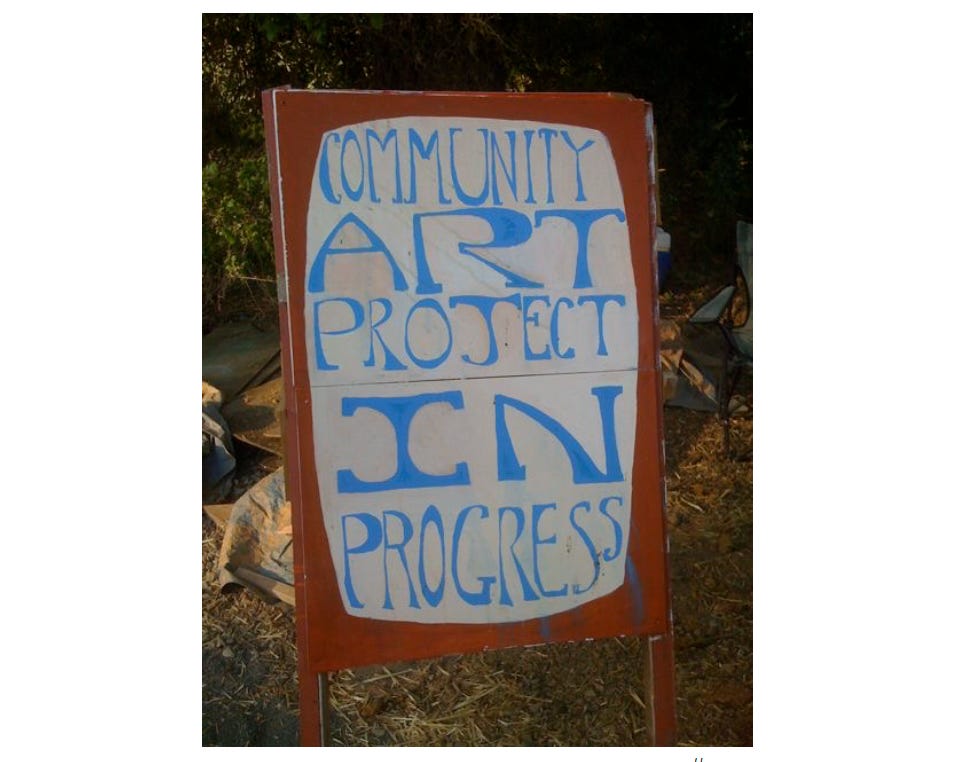
This, our first such project, needed to welcome everyone. People could stand and watch, if that’s what they wanted, or get as involved as they would like. everyone was welcome.
That was the point. The location was chosen carefully: a pedestrian corridor where hundreds of cars passed each day, where kids walked to school and adults to the grocery store—people who would never think to sign up for a volunteer project or who didn’t imagine themselves as artists or builders or community members in any organized sense. The barrier we were aiming at wasn’t apathy. It was the story people told themselves about who gets to participate.
So we didn’t advertise. We just showed up with clay and started mixing.
Massey Burke was the project lead — an artist who had fallen in love with natural building and at the time taught cob construction at the Solar Living Center in Hopland. She had a quality that no committee could manufacture: she made people feel genuinely welcome.
I obtained permission from the county, and plunged my own feet into the mud.
After that, it belonged to whoever stopped to watch.
And they did stop. First to look. Then to ask. A high school student asked if we’d sign off on his community service hours if he helped make adobe bricks. Of course. A woman in a wheelchair spent a full day working on the bench. Retirees drifted over, watched for a while, and found themselves pressing clay plaster into the structure with their hands.
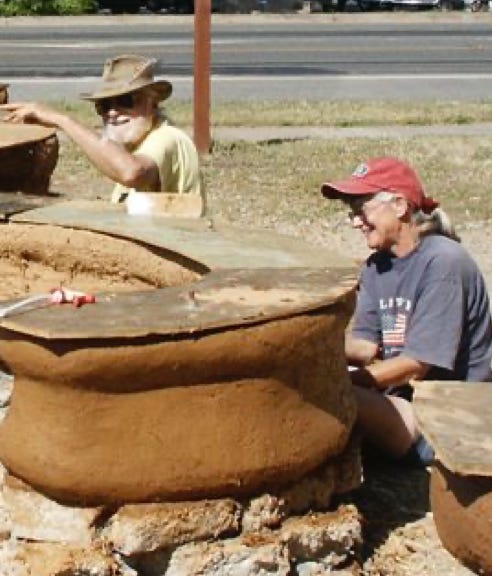
One morning an older man showed up and asked if he could help. He stayed through the afternoon, quiet and steady, working the wet reddish-brown clay into the arch. Most people stayed an hour, maybe two, and vanished before cleanup. This fellow stayed for cleanup. When the last bucket was rinsed and the tarps were folded and loaded into the truck, he looked at Massey and said: “Thank you for this.”
“It was fun!” she said.
“More than that,” he said. He paused. “I’m a former marine. Served in combat.” His voice trailed off. Then: “This is the most important thing I have done in my life.”
The plan was to build a bench and invite people to help. A small project. That is not to say it wasn’t strategic. It was. We wanted to address that barrier to community projects—a lack of volunteers, leaving the same people to do all the work. We chose to issue that simple, easy-to-access invitation: “Community Art Project in Progress.”
Over sixty people volunteered before it was finished. The project went on to win a statewide Green California Leadership Award for cultural change initiatives, and more importantly, it led to people saying “that was fun,” increasing the likelihood that they would volunteer again.
And we built a bench.
Yes, nature has been creating life in devastated landscapes since life began on this planet. Life, in its own way is the result of billions and billions of tiny experiments. As it happens, some of them worked out.
I have been thinking lately about what it means to begin. Not to build consensus around a plan or a shared theory of change — but to actually begin creating something. Something beautiful. Or something fun. Or something vital.
A seed ball doesn’t ask for permission.
It doesn’t require a coalition, a fiscal sponsor, or a line item in next year’s budget. It asks only for hands willing to make it and an arm willing to throw it. Cast it into the right ground, and something happens. You may not see it right away. You may not even be there when it sprouts. But the landscape shifts in the direction of life.
That is enough. That may be, in fact, everything.
Inspiring - I needed that!